Chatbot AI - Search Assistant
- 4.4
- Rating
- 10.00M
- Installs
- Free
- Price

 Analysis by App-foxy
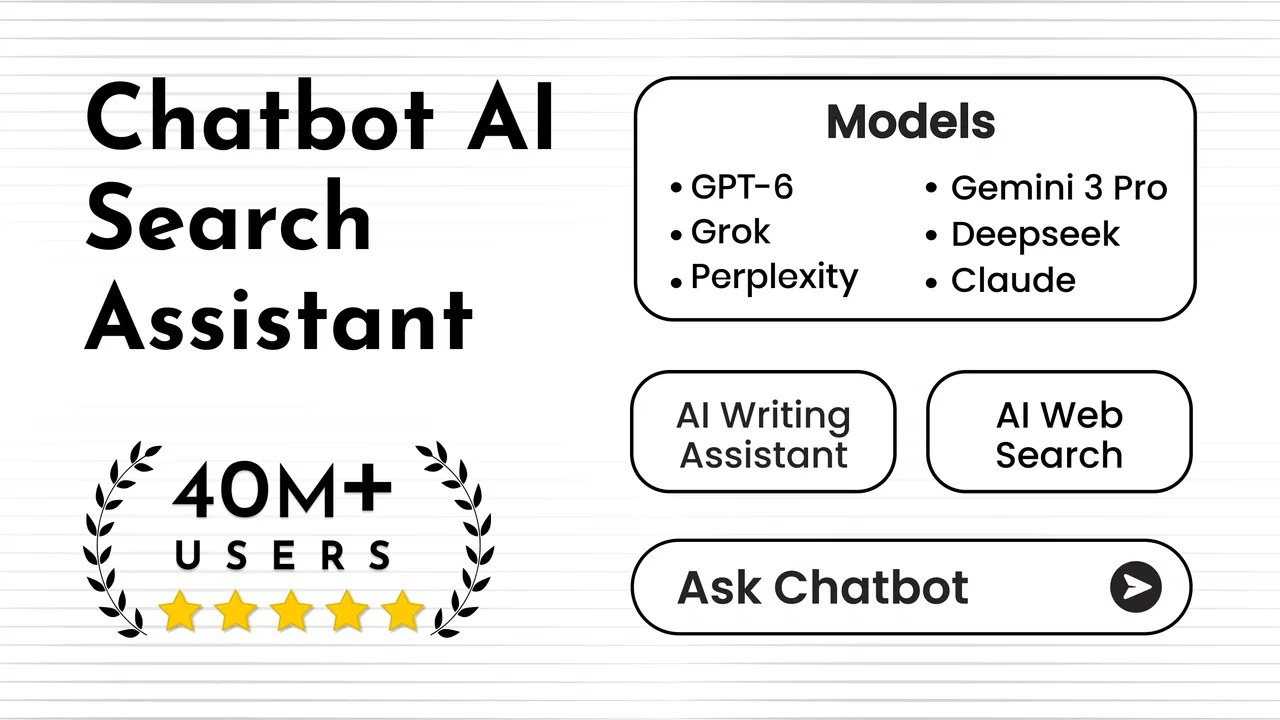
I usually open an AI assistant with a very specific problem: I have a rough question, a half-formed idea, or several pieces of information that need turning into something useful. Chatbot AI - Search Assistant is built for that moment. It is a free productivity app from Codespace Dijital that combines conversational help with search-oriented answers, web browsing, and generation tools. In my experience, its main appeal is not simply “asking a chatbot” but moving from a vague starting point toward a usable result without switching between several separate apps.
The app has become a substantial choice in its category, with an average rating of 4.4 from around 853 thousand ratings and more than 10 million installs. Those figures suggest that it is not a niche experiment, but popularity does not remove the need to understand how it fits into a real workflow. I found it most useful when I treated it as a flexible first assistant rather than an unquestionable source of truth.
From a rough question to a usable answer
When I use an AI assistant around other people, the key question is not just what it can answer, but how clearly I can keep each person’s task and context separate. This section looks at the practical boundary between a shared device and a shared conversation, then turns to simple habits that make household use more deliberate.
You May Also Like

 Blood Strike: 2.5 Anniversary
Blood Strike’s Loadouts Turn Every Drop Into a Tactical Gamble
A close look at Blood Strike’s custom loadouts: how fast access to signature weapons reshapes its battle royale rhythm, rewards preparation, and narrows the gap between fights.

 Pandora - Music & Podcasts
Pandora’s Music Is Easy to Start, but Harder to Recover
Pandora’s strength is its low-effort path from a seed to a station. Its weak spot is how much confidence it asks you to place in connection, setup, and quiet recovery.

 8 Ball Pool
 Is Built on Rivalries, Rematches, and Routine
A close look at the rivalries, rematches, shared routines, and unanswered safety questions that turn a quick pool match into a persistent mobile community.

 Samsung Music
’s Quiet Strength Is Playing What You Already Own
Its reach comes less from spectacle than from dependable access to a personal library. That simplicity is both the app’s strongest retention engine and its ceiling.

 AccuWeather: Weather Radar
AccuWeather Review: A Quick, Clear Forecast for Everyday Decisions
For everyday plans, the best forecast is the one you can understand quickly. AccuWeather makes rain timing, radar, and local conditions easy to act on, with a few trade-offs.

 Hill Climb Racing
Why Hill Climb Racing Still Turns Crashes Into One More Run
A tiny car, a bumpy hill and one more upgrade: Hill Climb Racing keeps resurfacing because its simple chaos makes every near-miss feel personal.
More From Our News Desk



Starting with the problem instead of the tool
The best way to begin is to decide what kind of help I actually need. If I want a quick explanation, I can phrase the request like a normal conversation. If the subject depends on current information, I need to make the search and browsing aspect central to the request. If I want a finished draft, outline, idea list, or other generated material, I get better results by describing the intended audience, tone, and format instead of typing only a few keywords.
This distinction matters because a short prompt often produces a broad answer. For example, “help me plan a weekend trip” leaves many important choices unstated. A more useful request includes the destination, available time, interests, budget limits, and whether I want research or simply a creative itinerary. The app can then act as a starting point for planning rather than a generic text generator.
I also found that the first answer should be treated as a draft of the conversation, not the final destination. The practical advantage of a chatbot is that I can refine the request in stages: ask for a shorter version, request a clearer structure, challenge an assumption, or ask it to separate confirmed details from suggestions. This is more natural than rebuilding a search query from scratch every time my needs change.
The step-by-step flow
My usual workflow begins with one plain-language request. I then inspect the response for three things: whether it understood the task, whether it used the right level of detail, and whether it distinguished facts from interpretation. If the answer is too general, I add constraints. If it is too confident, I ask for the reasoning or for points that need checking. If the task is creative, I focus less on factual certainty and more on whether the proposed result matches the purpose.
For research-style requests, the search and web-browsing angle becomes more important. I use it to gather an initial map of a topic, identify terms I should investigate, or compare several directions before opening a dedicated source. That handoff is valuable because it reduces the blank-page problem. Instead of searching randomly, I can ask the assistant to organize the question first and then use the resulting keywords or subtopics for deeper checking.
A useful, less obvious habit is to ask for a “decision brief” rather than a long explanation. I can request the main options, the trade-offs, the information that would change the recommendation, and the next action. This format is particularly helpful when I am choosing software, preparing a purchase shortlist, or deciding how to approach a work task. It keeps the conversation connected to an outcome instead of rewarding length for its own sake.
For generation tasks, I get more control when I separate content from presentation. First I ask for the substance: ideas, points, or a rough draft. Then I ask Chatbot AI - Search Assistant to reshape it for the destination, such as a message, checklist, study note, or social post. This two-pass workflow is usually more reliable than asking for a polished final result immediately, because I can correct the underlying direction before spending time on wording.
Where the handoffs happen
The app is strongest at the handoff between thinking and doing. A person may begin with a question, move into research, then need a summary or a generated draft. Those stages normally require a search engine, a notes app, and a writing tool. Here, they can be handled in one conversational space, which makes the process feel less fragmented.
Still, the handoff to external verification remains important. I would not use an AI-generated answer as the sole basis for medical, legal, financial, academic, or safety-critical decisions. Even when web browsing is involved, a clear-looking response can still misread a source or combine details incorrectly. My approach is to ask the app for a concise research map, then check the original pages or authoritative material before acting.
The same caution applies to generated writing. The app can help me overcome inertia, improve structure, and produce alternatives, but I still need to review names, dates, claims, tone, and implied promises. A generated email may sound polished while quietly committing me to something I did not intend. The final handoff should always be from the assistant’s draft to my own judgment.
A realistic everyday workflow
Imagine that I need to prepare a short presentation for a team meeting. I might begin by asking for a simple structure based on the topic and the audience. After reviewing it, I can request a version organized around a problem, evidence, options, and recommendation. Next, I can ask for questions the audience may raise and concise responses to each one. Finally, I can turn the material into speaker notes or a compact checklist for the meeting.
That sequence shows the app’s practical value better than a single impressive answer. The initial request creates direction, the follow-up questions expose weak points, the generation step turns ideas into usable material, and the final review gives me something I can carry into the meeting. If the topic includes current facts, I would use the search-oriented part of the workflow to identify sources and confirm the details before presenting them.
Another everyday example is studying. I can ask for an explanation at a beginner level, then request an analogy, a short self-test, and a list of common mistakes. The important insight is to use the assistant as an interactive tutor rather than copying its first explanation into notes. Asking it to quiz me or reveal the answer only after I respond turns passive reading into a more active process.
For personal organization, I can start with an untidy list of obligations and ask for categories, priorities, and a realistic order of attack. I would not expect the app to know my actual schedule unless I provide it, but it can help convert mental clutter into a plan. The key trade-off is convenience versus context: the more relevant information I include, the more useful the result becomes, but I should avoid sharing sensitive personal details unnecessarily.
What the result feels like in practice
The result is best understood as accelerated preparation. I can move from “I do not know where to start” to a set of options, a draft, or a clearer question much faster than I could by staring at an empty document. The conversational format also makes revision less intimidating. Instead of editing every sentence manually, I can describe the change I want and ask for another pass.
Its search and browsing capabilities add a second layer to that experience. They are useful when I need orientation around a subject that may have changing information, while the generator side is more useful when the facts are already known and the challenge is expression. Keeping those purposes separate helps me judge the output properly: a creative draft is evaluated for usefulness and fit, while research content needs source checking.
I also appreciate that the app is accessible to a broad audience. It is rated for Everyone, and the minimum operating-system requirement is Android 7.0, making it available on many older Android devices. The current version is 3.0.28. Those details make it a practical option for people who do not have a recent flagship phone, although the experience will still depend on the device and connection used.
Friction, limits, and the point where the flow breaks
The first limitation is that a fluent response can create false confidence. The app may give me a neatly organized answer before I have supplied enough context, and that neatness can hide uncertainty. I have to slow down when the subject is specialized or time-sensitive. Asking for sources, assumptions, and unresolved points helps, but it does not replace checking the underlying material.
The second limitation is prompt effort. The app is not a magic shortcut that removes the need to think. If I provide an unclear request, I may receive an equally unclear result and then blame the tool for a problem caused by missing context. Users who want a conventional search box, direct links, and complete control over every result may prefer a standard search engine for fact-finding.
There is also a difference between drafting and finishing. Chatbot AI - Search Assistant can help produce a strong first version, but personal voice, accuracy, and final judgment still belong to me. For long documents, complex research, or work that requires careful citation management, a dedicated writing or reference workflow may be better. The app is a capable bridge, not necessarily a complete replacement for every specialized tool.
Cost is another practical consideration. The app itself is free, while in-app purchases range from $4.99 to $69.99 per item. I would begin with the free experience and decide whether the way I use it justifies any purchase. Someone who only needs occasional brainstorming may have no reason to pay, while a frequent user may value expanded access depending on the available options. The important point is to judge the purchase against a real recurring workflow rather than the novelty of trying AI once.
Privacy-minded users should also apply normal caution with conversational tools. I would avoid entering passwords, confidential business material, private identification details, or information about another person that I would not place into an online service. Even when I am only asking for writing help, replacing real names and sensitive specifics with neutral placeholders is an easy habit that preserves much of the usefulness.
Who should use it and who should skip it
I would recommend it to students who want explanations and practice questions, workers who regularly turn rough ideas into drafts, and curious users who need help organizing research before going deeper. It is especially suitable for people who move between questions, browsing, and content generation during the same task. The conversational approach rewards users who are willing to refine an answer instead of expecting perfection from one prompt.
I would be more cautious about recommending it to someone who needs a source-first research database, a specialized project-management system, or guaranteed professional advice. It is also not the best fit for a person who dislikes conversational interfaces and wants a simple list of manually verified search results. In those cases, a dedicated alternative may offer better control, clearer provenance, or more structured records.
My strongest tip is to finish every important session with an action request: ask for the next steps, a checklist, questions to verify, or a version ready to review. That turns an interesting conversation into something operational. A second tip is to ask the assistant to expose assumptions before accepting a recommendation. A third is to keep a distinction between “help me explore” and “help me confirm”; those are different jobs, and mixing them is where many disappointing results begin.
My final assessment
Chatbot AI - Search Assistant is a useful productivity companion when I need to move from uncertainty to a workable next step. Its combination of conversation, search-oriented assistance, web browsing, and generators makes it more flexible than a basic chatbot or a conventional search box used alone. I found the most value in the handoffs: framing a question, gathering direction, reshaping the material, and leaving the app with a draft or plan I can verify and use.
It is not a substitute for original sources, expert advice, or careful editing, and its smooth writing can make weak information look stronger than it is. Used with that limitation in mind, it becomes a practical first stop for research preparation, studying, brainstorming, and everyday writing. With a free starting point, an Everyone age rating, and a large existing user base, the app is worth trying if you want one conversational workspace for turning rough input into a clearer outcome.
FAQs for Chatbot AI - Search Assistant
01What is Chatbot AI - Search Assistant used for?
Chatbot AI - Search Assistant is designed to assist users in conducting efficient searches across multiple platforms and databases. It leverages advanced artificial intelligence to understand natural language queries, making it easier to find information quickly and accurately. This app is ideal for anyone looking to streamline their search process.
02Is Chatbot AI - Search Assistant free to use?
Chatbot AI - Search Assistant offers a freemium model. The basic features are available for free, allowing users to perform standard searches and access essential functionalities. However, for advanced features like personalized search results, ad-free experience, or priority support, users may need to subscribe to a premium plan.
03How does Chatbot AI - Search Assistant ensure user privacy?
User privacy is a top priority for Chatbot AI - Search Assistant. The app adheres to strict data protection regulations and uses encryption to safeguard personal information. It does not store or share search histories with third parties without explicit user consent, ensuring a secure and private search experience.
04Can Chatbot AI - Search Assistant integrate with other apps?
Yes, Chatbot AI - Search Assistant is designed for seamless integration with various third-party apps and services. It can connect with productivity tools, smart home devices, and other applications to enhance functionality and provide a more cohesive user experience. Check compatibility with specific apps in the app settings.
05What devices support Chatbot AI - Search Assistant?
Chatbot AI - Search Assistant is available for both Android and iOS devices. It supports a wide range of smartphones and tablets, ensuring that users can access its features on the go. Regular updates ensure compatibility with the latest operating systems and device models.
Pros
- User-friendly interface with intuitive navigation.
- Supports multiple languages for diverse users.
- Quick response time with accurate answers.
- Integrates seamlessly with other apps.
- Customizable settings for personalized experience.
Cons
- Limited offline functionality.
- Occasional inaccuracies in complex queries.
- Requires stable internet for optimal use.
- Some features locked behind paywall.
- Can drain battery with prolonged use.

Chatbot AI - Search Assistant
Gallery